
Lab Barcodes: How Sample Tracking Works
The barcode is the sample’s identity, not a label. How tracking works from registration to report, and how an analyzer result finds the right patient.
In a laboratory the barcode is not a label — it is the sample’s identity. Once a tube is drawn and capped, the patient’s name is no longer attached to it in any way a machine can read. The number is. Every later step, including the analyzer sending its result back, works by matching that number and nothing else.
That is worth stating plainly because it explains why barcode discipline matters more than almost any other habit on the bench.
What happens, in order
- The bill is saved and the software mints a number for each tube the ordered tests require.
- The label prints and goes on the tube at the point of draw — not later, and not from memory.
- The tube reaches the bench and is scanned as received, so anything not scanned is visibly still pending.
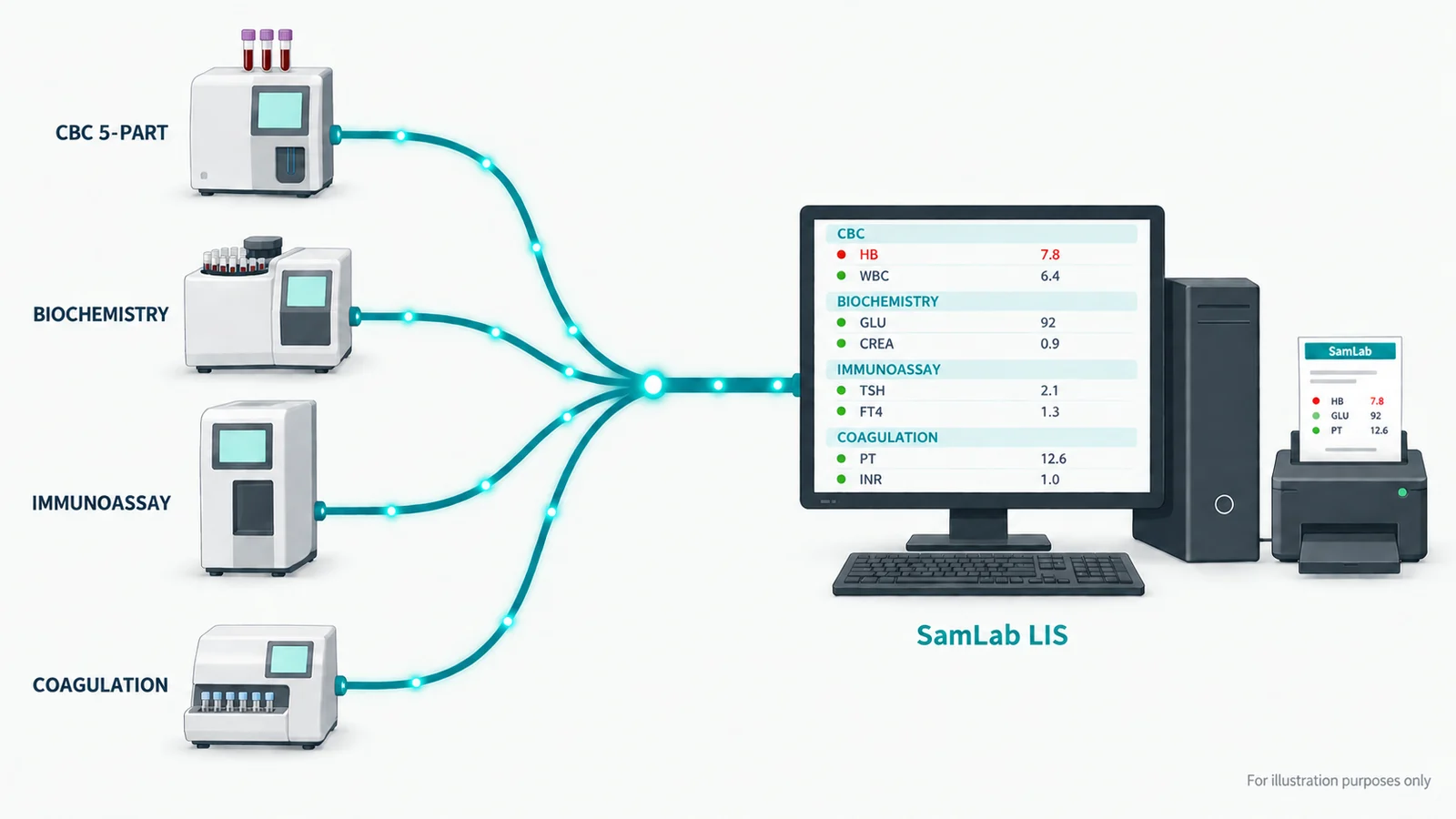
- The analyzer reads the barcode off the tube and includes it with every result it sends back.
- The software matches that number and files the values against the right patient and the right test.
One patient can need three barcodes
Tests are grouped by the tube they need — EDTA for a CBC, plain or serum for liver function, fluoride for glucose. A bill with tests across three tube types is three physical tubes, and the software should mint a number for each and know which tests live on which tube. A single number issued for a three-tube bill is how a biochemistry result ends up looking for a haematology sample, and the error surfaces late.
Printed versus pre-printed labels
Most laboratories let the software print the label at registration. Some — particularly government and hospital-attached labs — buy pre-printed barcode rolls or sheets and need to type that number in instead. Both work, and the rule is the same either way: the number on the tube and the number in the record must be the same number.
A system that mints its own while the tube wears a different one has created two identities for one specimen, and the bench will be holding the one that is not in the database. If your lab uses pre-printed labels, check that the software can accept a typed number and make it the sample’s real identity rather than storing it as a side note.
The check that matters most
Before any typed barcode is accepted, the software must refuse a number that already belongs to another patient. This single check stands between a busy counter and a result filed against the wrong person, and it is the one thing worth confirming in a demo. A system that silently accepts a duplicate, or quietly adds a suffix to make it unique, has moved the problem somewhere you will not see it.
What good tracking gives back
| What you get | Why it matters |
|---|---|
| Pending work is visible | Which tubes were drawn, which arrived, which are still out — without asking anyone |
| Rejections are recorded | Haemolysed, clotted or insufficient, with a reason held against the sample |
| Add-on tests reuse the tube | A test added later can ride a vial already drawn instead of recalling the patient |
| Turnaround time becomes measurable | Every stage carries a timestamp, so TAT is a report rather than an estimate |
That last row is the one accreditation assessors ask about, and it is produced as a by-product rather than maintained by hand. See how analyzer results bind to the barcode
Practical notes on the label itself
- A small direct-thermal label printer is enough — a dedicated one at the collection point, not the office laser.
- Do not print labels on ordinary paper and tape them on. They come off in the centrifuge, and a tube with no identity is a tube that has to be drawn again.
- Keep the printed number short enough to read aloud. It will be keyed into an analyzer by hand on the day the scanner fails.
- Put the label where the analyzer expects to read it — most machines scan a specific band of the tube.
Frequently asked questions
Do I need a barcode printer to start?+
A small direct-thermal label printer is enough, and it belongs at the collection point rather than in the office. Labels printed on paper and taped to tubes do not survive a centrifuge.
Can I use barcode labels I already buy pre-printed?+
Yes, provided the software lets you enter that number and makes it the sample’s identity rather than inventing a second one alongside it.
What happens if the analyzer cannot read the barcode?+
The number is keyed into the analyzer by hand and the matching works exactly the same way. It is slower, and it is why a shorter printed number is worth having.
Why did a result attach to the wrong test?+
Usually because one number was issued for a bill that needed several tubes, so the software could not tell which specimen a result belonged to. Each tube type needs its own barcode.
Keep reading
- How to Connect an Analyzer to Your LIS
Four things have to line up before an analyzer result reaches a patient record — the cable, the machine’s own interface setting, the matching settings in the software, and a barcode it recognises. Here is how to get each one right, and how to tell which is wrong.
- Best LIS Software in 2026: How to Choose
There is no single best LIS, only the best fit for a laboratory of your size, in your regulatory regime, with your analyzers. This guide sorts the market into categories and gives you the questions that actually separate them.
- ASTM, HL7 and LIS2-A2: Analyzer Protocols
Analyzer integration sounds like magic and is mostly two standards, a cable and a field map. Knowing which is which makes vendor conversations much shorter.